
Why Kids Love Re Reading the Same Book Again and Again
- Daniel Carr
- 4 days ago
- 8 min read
You reach the final page. You soften your voice, close the book, and enjoy that tiny pause at the end of a story.
Then it comes.
“Again!”
For many adults, this can feel a little puzzling. Surely the fun is in finding out what happens next. Surely once the dragon has been beaten, the lost teddy has been found, or the cheeky squirrel has caused chaos for the third time, the story is finished.
Children see it differently.
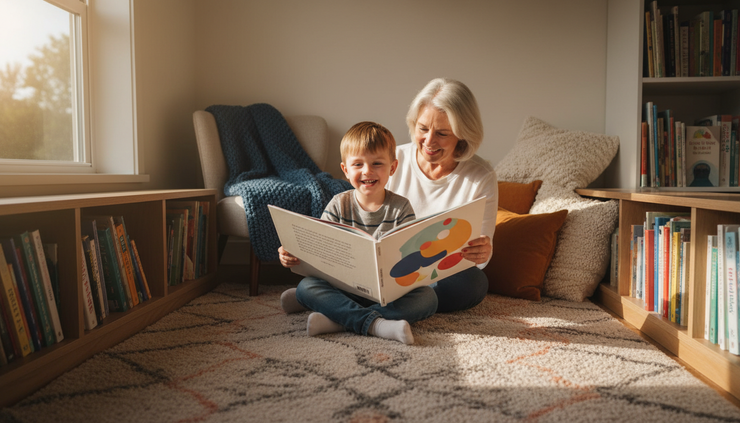
When a child asks for the same book for the tenth night in a row, they are not simply repeating an old experience. They are building a new one. They are hearing familiar words with fresh confidence. They are spotting tiny details they missed before. They are enjoying the warm feeling of knowing what comes next.
To an adult, it may look like the same book.
To a child, it is a place they can return to, explore, and understand a little more each time.

Repetition feels safe and satisfying
Children live in a world full of new things. New words. New rules. New places. New emotions. Even ordinary days can be packed with surprises.
A familiar book gives them something steady.
They know the bear will fall into the pond. They know the tiny mouse will appear behind the tree. They know the silly sentence is coming, and they may already be giggling before it arrives.
That sense of knowing matters. It gives children a feeling of control. In a story they already love, they are no longer just following along. They are taking part.
They can predict.
They can remember.
They can join in.
This is one reason bedtime favourites become so powerful. At the end of the day, when a child may be tired or overstimulated, a familiar story can feel calming. The rhythm of the words, the turn of the pages, and the repeated voices all become part of a comforting routine.
There is pleasure in surprise, but there is also pleasure in certainty. Adults feel this too. We rewatch favourite films, return to songs we know by heart, and cook meals that taste exactly as we remember. Children do the same with books, often with even more enthusiasm.
The story becomes a small, safe world. They know the way in. They know the way out. That makes it easier to relax and enjoy the journey.
Every reading gives them something new to notice
The first time a child hears a story, they may focus on the big event. Who is lost? Who is hiding? What happens when the door opens? Will the little rabbit get home?
The second time, they may notice a funny face in the corner.
The third time, they may spot that the umbrella was blue on one page and then lying under the chair on the next.
The fourth time, they may realise a tiny background character has been doing something strange all along.
This is one of the quiet joys of picture books. Children do not read only the words. They read the whole page.
They study the illustrations. They search the corners. They follow a character’s expression. They notice patterns adults often miss because adults are too busy moving the story forward.
A child may stop you halfway through a sentence to point out a cat on a windowsill. That cat may not matter to the plot at all, but it matters to them. It has become part of the adventure.
This is why re-reading can feel completely fresh. The book has not changed, but the child’s attention has.
They may ask new questions:
“Why is that character sad?”
“Where did the hat go?”
“Is that the same bird from before?”
“What is hiding behind the tree?”
“Why did they do that?”
Those questions show that the child is not passively listening. They are exploring, connecting, guessing, and making meaning.
The same page can hold a dozen small discoveries. A child simply needs time to find them.

Picture book details reward curious readers
Many picture books are built for repeat visits. The main story may be simple, but the pages often contain little extras for children who look closely.
A character might pull a silly face in the background.
A toy might appear in a different place on every spread.
A tiny clue might hint at what will happen later.
A familiar little friend might hide somewhere on each page, waiting to be found.
These details are not always needed to understand the story. That is what makes them special. They reward attention. They make children feel clever. They invite them to slow down.
For a child, finding one of these details can be just as exciting as reaching the end of the story. Sometimes it is more exciting, because they found it themselves.
This changes the reading experience. The child is no longer only being read to. They are helping to read the book.
They might say, “There it is!” before you even see what they mean.
They might remember a hidden object from last time and search for it again.
They might notice that a character in the background tells a little story of their own, page by page.
This is why rich illustrations matter so much. A good picture book does more than decorate the words. It creates a world with room to play.
For very young children, those details can be a doorway into storytelling. They may not read the printed words yet, but they can still read expressions, colours, movement, and tiny visual clues.
A frown tells them something.
A muddy footprint tells them something.
A missing biscuit tells them something.
Page by page, they learn that stories are made from details. They begin to understand cause and effect, character, setting, and humour, even before they have names for those things.
And because the book is familiar, they feel brave enough to explore it.
Knowing what comes next builds confidence
One of the loveliest things about re-reading is the moment a child begins to take over.
At first, they listen.
Then they point.
Then they join in with a repeated phrase.
Soon they are finishing sentences, correcting skipped words, and telling you what happens before you turn the page.
This is not just cute. It is a sign of growing confidence.
When children know a story well, they can practise language in a low-pressure way. They hear the same words and sentence patterns again and again. They begin to remember rhythm and phrasing. They learn how stories sound.
A repeated line can become their line. A silly noise can become their performance. A favourite page can become their moment to shine.
This is especially powerful because success comes naturally. No one has to test them. No one has to say, “Can you remember what happens?” They want to show what they know because the story feels joyful.
Re-reading also helps children practise prediction. When they know what happens next, they can enjoy being right. That feeling matters. It tells them, “I understand this.”
Over time, they may begin to predict in new books too. They learn that stories often follow patterns. Problems build. Characters try things. Clues matter. Endings answer questions.
A familiar book becomes practice for reading the world.
Re-reading turns listeners into storytellers
There is a quiet shift that happens after a child has heard a book many times.
They stop waiting for the story to be given to them.
They start giving it back.
They retell the plot in their own words. They explain what a character is feeling. They add sound effects. They point out the page where “the funny bit” happens. They may even change the story, adding a new ending or making a side character the hero.
This is a big step. It shows that the story has moved from the page into the child’s imagination.
When children re-read, they are not only memorising. They are learning how stories work from the inside. They begin to understand that a story has a beginning, a problem, a middle, and an ending. They notice that characters want things. They see that small clues can matter later.
They also learn that their own observations have value.
If a child says, “Look, the little bird is on every page,” they are doing more than finding a bird. They are making a connection across the book. They are tracking a visual thread. They are paying close attention.
That kind of attention is a gift.
It is easy for adults to rush past it. We may want to finish the page, keep the routine moving, or get to bedtime. But when a child stops to show us something, they are inviting us into their way of reading.
And often, their way is wonderfully alive.
Adults miss details because they read differently
There is a funny truth about shared reading. Children often notice things adults miss.
Adults tend to follow the main path. We read the words. We keep the pace. We focus on the plot.
Children wander.
They look at the background. They inspect the edges. They notice the odd sock, the tiny snail, the character peeping through a window, or the biscuit crumb that appears three pages before anyone mentions biscuits.
This is not distraction. It is attention of a different kind.
For adults, the story may live in the text. For children, the story lives everywhere on the page.
That is one reason picture books can be so rewarding to read together. A child’s curiosity slows the adult down. It reminds us that books are not only something to finish. They are something to spend time with.
The next time a child interrupts with, “Wait, look!” it may be worth pausing.
They may have found a joke.
They may have spotted a clue.
They may have noticed a detail the illustrator planted there for exactly that moment.
And yes, they may want to talk about it for longer than expected. That is part of the reading too.

The tenth reading might be the richest one
When a child asks for a book again, it can be tempting to steer them towards something new. New books are wonderful, of course. Variety matters. Fresh stories bring fresh words, ideas, and worlds.
But familiar books offer something different.
They offer depth.
A first reading often answers the biggest question: what happens?
Later readings answer smaller, richer questions: what else is happening? How did I miss that? Why does this part feel funny? Can I say the line too? Can I find the hidden friend before anyone else?
That is the real magic of re-reading.
The book becomes less like a straight road and more like a garden path, full of corners to inspect. A child returns not because they have failed to move on, but because they know there is more to find.
So when the cover closes and the small voice says, “Again,” it may help to pause before saying no.
Maybe they want the comfort of the familiar.
Maybe they want to hear their favourite line.
Maybe they want to feel clever because they know what comes next.
Or maybe they have spotted something on page six that you have never noticed, even after all those readings.
The biggest adventures are not always in the main plot. Sometimes they are hiding in a tiny expression, a strange footprint, a missing hat, or a little character tucked into the corner of the page.
That is why children love reading the same book again and again.
They are probably not hearing the same story.
They are discovering a new one.
Have you ever had a child point out something in a book that you completely missed? Share it in the comments. I would love to hear what they found.
Learning Through Adventure
Every book in the Griffin & Mythical Friends series combines magical storytelling with interactive fun.
Children can:
Search for hidden objects and characters.
Find Jbug on every page.
Solve secret messages and discover clues throughout each adventure.
Alongside every adventure, children also explore a different emotional theme, creating natural opportunities to talk about feelings, friendships, hope, trust, resilience and confidence while enjoying the story together.


Comments